Very nice - I like the ability to adjust the dust shoe height!
@gmckeown Thank you. I read that it was Z independant. It’s not, correct? It rides up and down with the spindle/gantry.
One issue that you may wish to avoid is the corners; they should ideally be slow sweeps. Instead of hard 90 degree turns, the usual idea is to have two 45 degree elbows. The same goes for your T-joints; try laying them out so that the direction of the airflow creates as little resistance as possible.
Aside from those issues (actually, they’re pretty well the same thing…), good going!
Marty from Kingston, ON 
1 Like
Thanks for the input.
The correct term for them would be “long sweep 90’s and sanitary tee’s.” I only know this because I was a really high end custom home builder for 42 plus years.
It wasn’t very high on my list of things to do when I put the dust collection pipes together. Those fittings are WAY more expensive than the fitting you see in the pictures. All of my runs are pretty short and not many fittings on each run. (Only one run has 4 fittings, the rest are 3 or less) The one with 4 fitting is only 18 feet long.
But it is good practice to use those fittings, for sure.
Its both. the rods let it float, or it can be held in place. The z axis can travel independently of the dust boot. The metal rods accomplish this. The orange knobs in the photo hold the rods for bit changes.
@gmckeown Tks, George. I admit that I am confused. The pics seem to show that the unit is attached to the spindle. That’s what threw me off. If it is attached to the spindle, it raises and lowers with the spindle. Correct?
Even as I am typing this, I may have finally understood. You can run it like that, or you can loosen the knobs and the brushes ride on the surface of the material???
It can’t be held in one place as a Z independant unit can. It can move with the spindle/Z gantry or it can float. Have I got it now?
Very interesting.
You have it. I wanted the best of both worlds. Fixed position with the spindle, or floating. I had tested a shoe what ran under the gantry and exhausted out the back, but is took too much off the Z usable height.
I am on the 4 iteration of my design that has a larger inlet. I’ll post and update once I have it working.
@gmckeown I’m slow but persistent.  I like your design. I have a LM Mk1 and I have played with numerous designs, mostly to eliminate the loss of X travel that comes from using the Sienci shoe. Mine were all Z independant. In the end, I settled for using the Sienci model. Mine actually did a better job of removing dust/chips, but the mounting brackets were causing grief with my Vortex. So now, I am accepting the X travel loss, but I have modified the Sienci bracket so that it does not interfere with the Vortex. I’ve designed a dust shoe for the Vortex that works reasonably well.
I’ll be following your progress. Thanks for explaining things.
Tracy, I don’t have a boom but we use retractable tool balancers in our factory. Dial up ‘Retractable tool balancers’ and there are lots of choices or perhaps give you some ideas. Bob,
1 Like
Sorry for the late reply. No it does not. I made sure the hose was long enough that it could reach all 4 corners with a bit of extra to prevent any stretching or stress on the hose or boot.
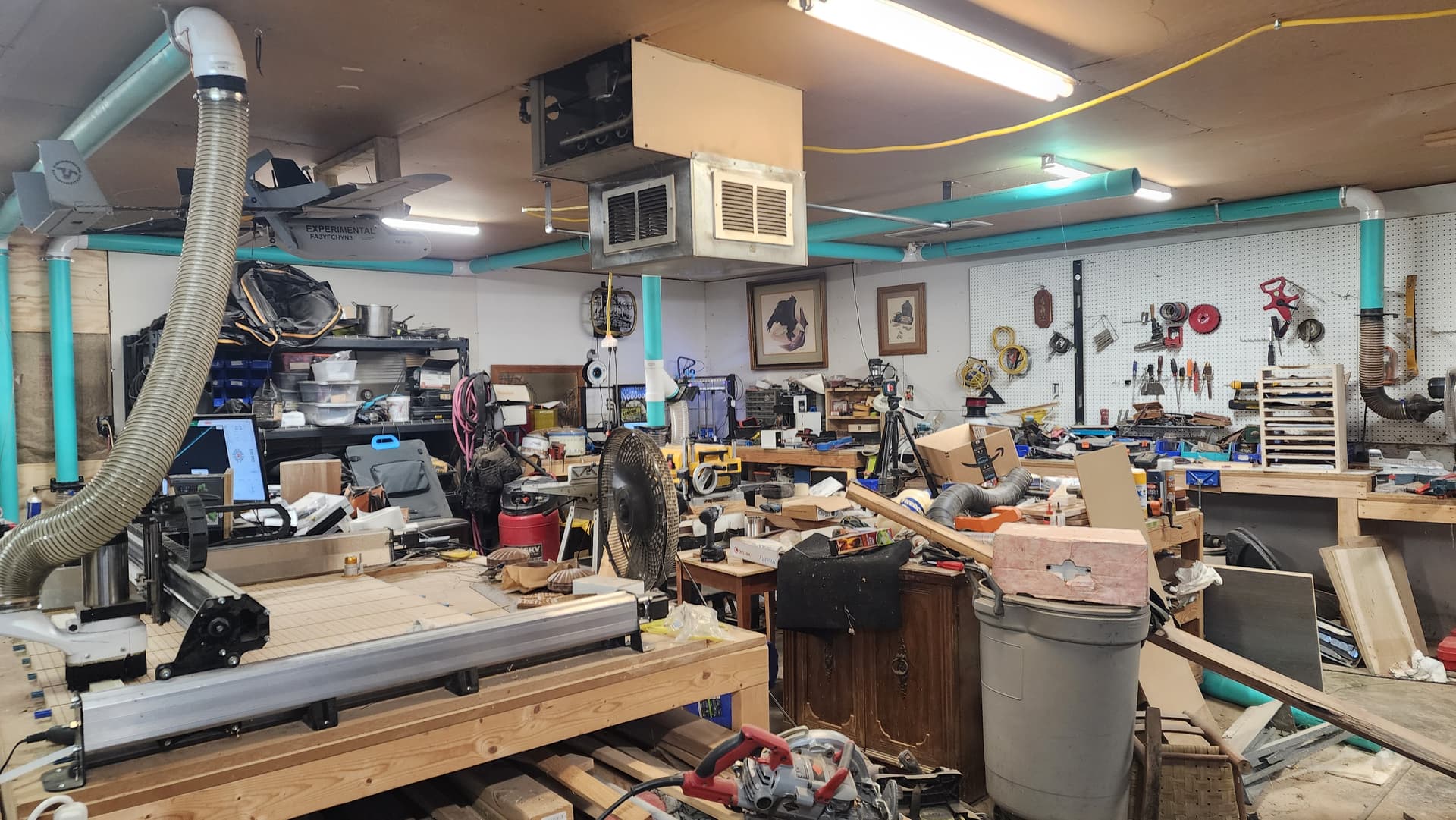
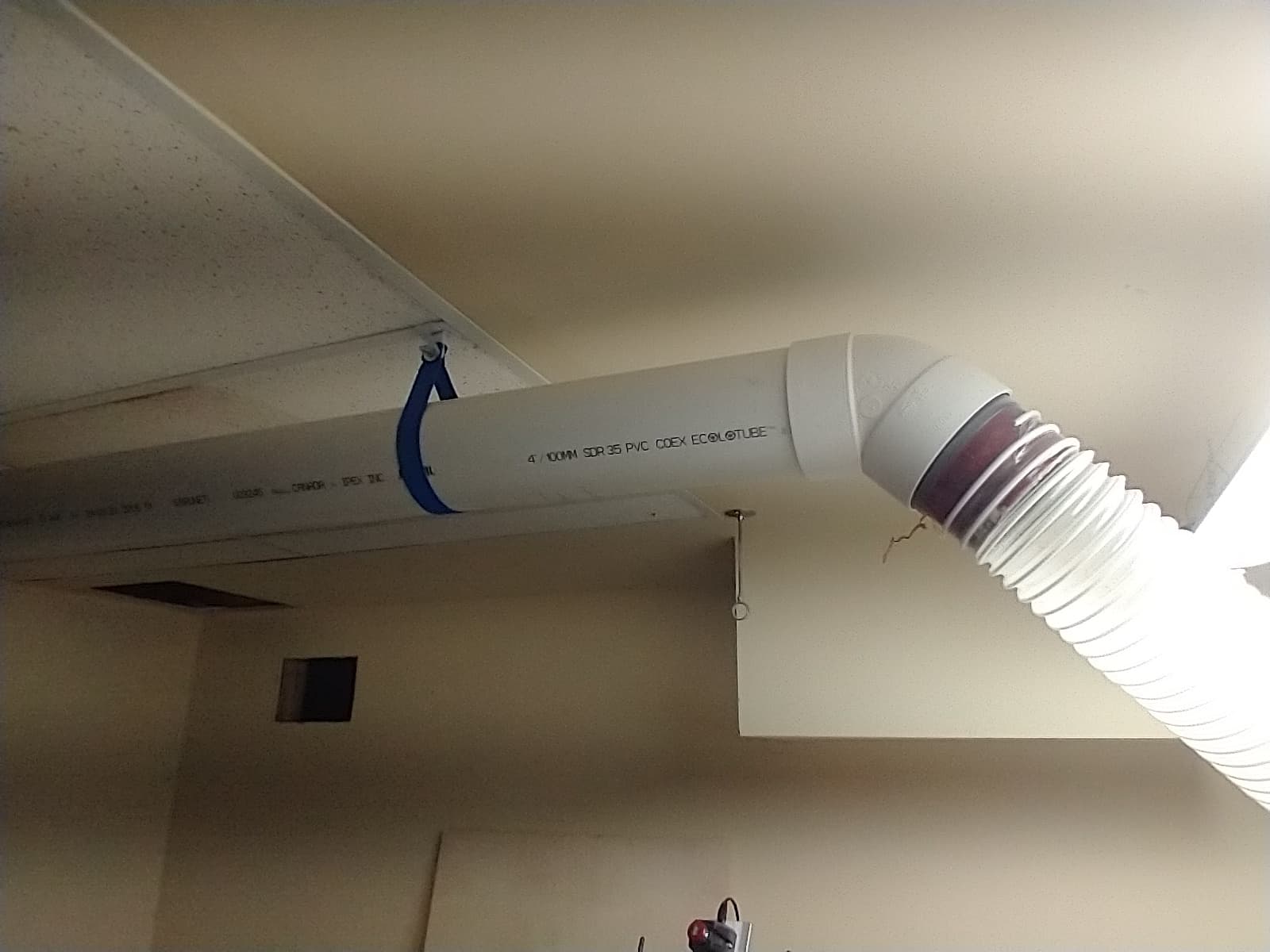
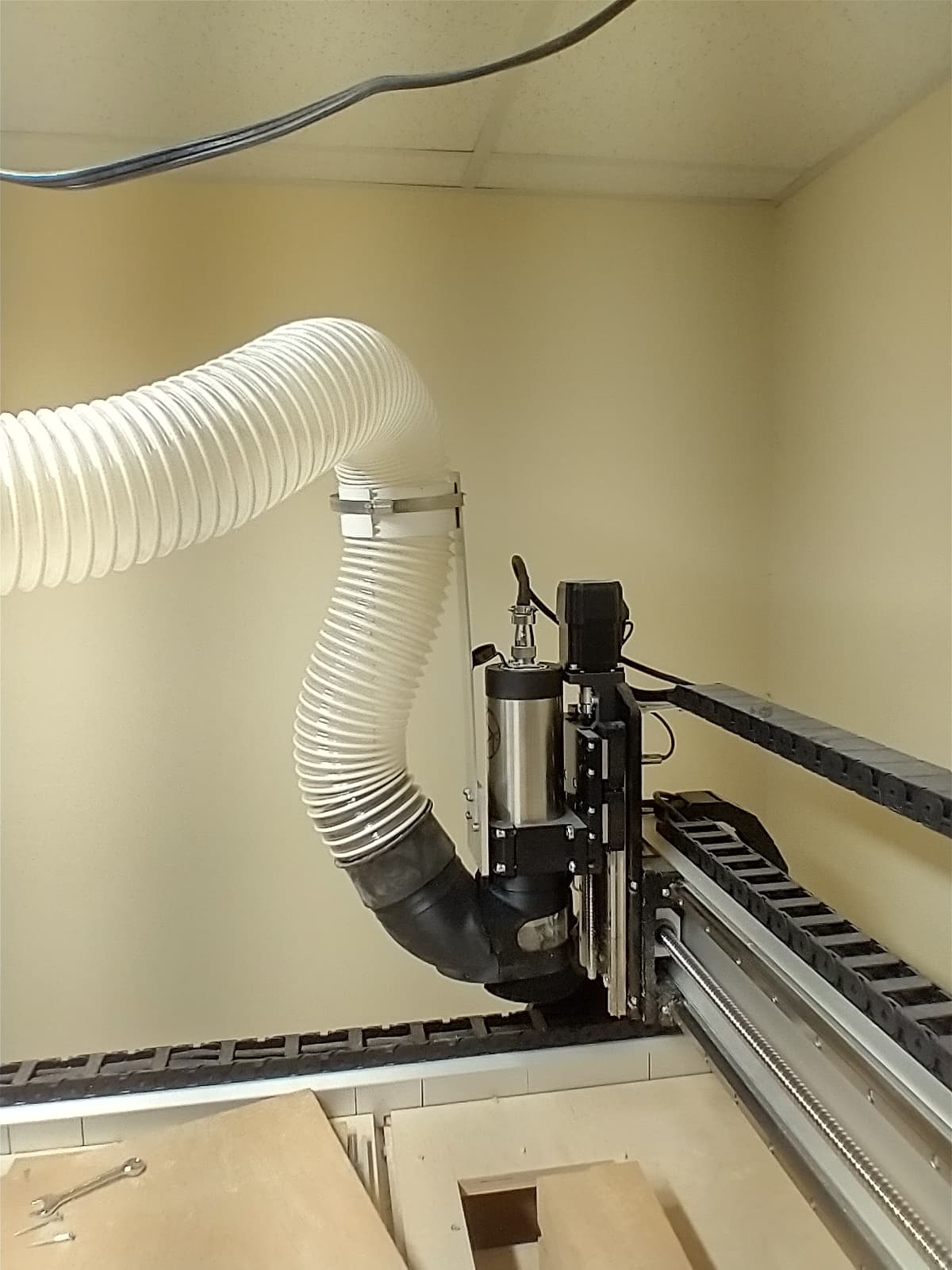
I struggled with several methods of 4" hose placement for my Altmill before coming up with a simple setup that works. Because I have low ceilings, it was difficult to get the hose high enough to clear the spindle as it moved around. I tried bungee cords, pivot arms, and a few other contraptions that didn’t work so well.
What finally did work is simply adding an extension arm to the spindle so that the hose can move freely to either side. The connection at the ceiling is about 12" in from the front of the Altmill. With this method, it is able to reach the back without issue. And when at the front, the hose simply plops from one side to the next as the spindle moves along the x-axis. Hose is not too long and not too short. Goldilocks length to prevent drooping or too much extension was achieved with a bit of trial and error.
2 Likes