Awesome video. Which changer model did you purchase?
Thanks for the explanation.
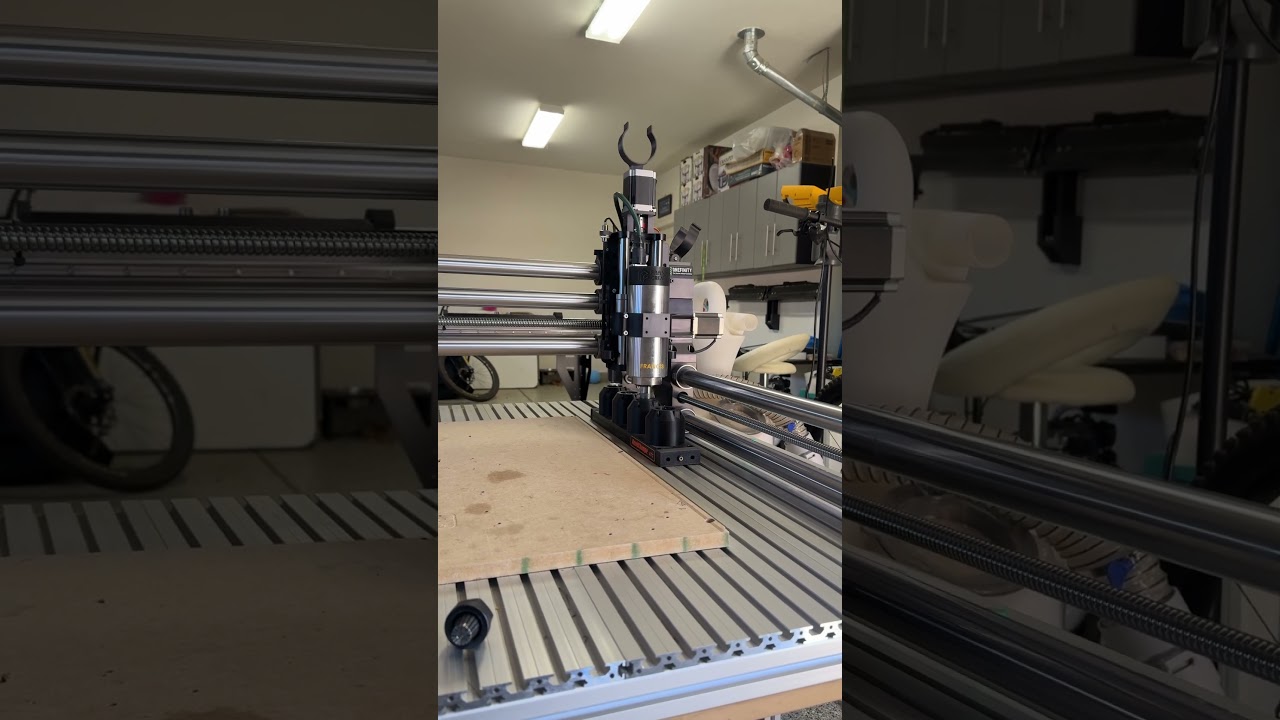
The dust boot is another thing that was on my mind. At first I thought that I could just leave the boot on during the tool changes but then I realized that the ATC depends on seeing the spindle nut to recognize a completed (or whatever) tool change. This of course would not be possible with the dust boot mounted.
Tool recognition are now working too. Just completed the setup and testing. This is a safety feature of RCA to pause the job incase the loading and unloading failed.
1 Like
The SD card you mention. What type micro sd card and size?
Also you say put it into the SLB+EXT (Alt Mill Controller).
Is there 2 types of SLB controllers?
1 Like
Yes. Alt Mill is using different version of SLB, it’s called SLB-EXT. It doesn’t have integrated stepper driver as Alt Mill already have integrated stepper close loop driver in the motor itself. Also, it’s 48v system so it has more power.
I’m using U3 micro sd card, Samsung brand.
Excellent introduction. I know just enough now to enthusiastically get me a 6 bit changer for my ER16 collets, and then wonder how to do it. I’m betting I can, though I may bother you again, and I bet I can afford it, because I got my first paying job!
1 Like
Hello, Total newbie with plans on and AltMill latter this year. I am just wondering if Sienci Labs plan on directly support this RC ATC. I am seeing some home grown versions of support but I am curious to see if the organization has this ATC on their radar and possibly somehow baking it into there release of GSender or possibly publishing a templates/recommended schema for using it with this AltMill controller. Again very new so appologies for any stupid questions, Steve
1 Like
Hey Steve, I don’t remember where I read or heard it but I believe sienci doesn’t plan on supporting Rapid Change ATC. They mentioned working with them on it, but they are working on their own system because they are concerned with the reliability of rapid change. I’m sure they won’t hinder the use of it but maybe won’t directly support/integrate.
1 Like
I would REALLY like to add an ATC and would prefer it be something either designed by or fully supported by Sienci.
Has there been any official statements of Sienci designing their own as you mentioned? I don’t mind waiting a while - I’m not a heavy user CNC user at the moment but definitely see that changing as I design more products in which the ATC would be a great time saver.
1 Like
It would be best if Sienci Labs designed and offered and in house ATC and I am willing to be patient. I think if they don’t announce their intentions to design/offer one by this time in 2026 I may go the the Rapid Change offering. Thanks all, Steve
2 Likes
what about warning on some spindles not to run them slower than 6000 or 9000 rpm. or they might be damaged? 1200rpm is pretty slow
Running a spindle below spec speed is only an issue if your running it for longer periods of time . The tool change is fairly quick process with out issues of over heating , and lots of tool changes tested .
the link doesn’t exist anymore. Can you share the doc
What do you know about this, I love to know more Any ETA ?
From their videos, it appears that Sienci is heading down the traditional ATC path with tool holders - a conservative approach that trades cost for reliability, track record and a bunch of other positive attributes. With no idea about what choices Sienci will make, a quick look for ER20 tool holders gives a range of $60 (Tormach) to $200 (Shopbot) for just the tool holders. You still will need collets and collet nuts for each tool holder. The good news is that the tool rack itself is so simple that it can be 3d printed and you can have as many tool holders as you have space for.
The RCATC makes different trade-offs in their quest to provide a lower cost solution by eliminating the tool holder and pneumatic drawbar mechanism. The RCATC system works by screwing and unscrewing the collet nuts from the spindle for each tool change.
As the meme goes, “what can possibly go wrong?” Things that come to mind include bit alignment, stickout, runout, consistent/sufficient clamping torque, reliability, etc…
The balancing consideration you/I need to provide is how much these differences matter to you based on how severe/frequent/significant you feel the failure modes might be. These, in turn, depend on your skill, your workload, your requirements and your budget.
An 8-position RCATC combined with Sienci’s spindle ($450 + 500 =$950) plus collets/nuts ((8 x 25) + (8 x 25) = $400) is about $1,400
A quick google search seems to show spindles with pneumatic tool changer in the ~2,000 to $3,000 range. This is double to triple the RCATC, and doesn’t include an additional $500 to $1,600 for the tool holders…
My evaluation of the questions above was that I was willing to invest an additional $500 for the RCATC and see if it worked - and if it didn’t, I was OK with manual tool changes. Because it was a “nice to have” for me, I didn’t feel it was worth doubling the cost of the base Altmill system to get a traditional ATC system…
3 Likes
I bought the 4 pocket RCATC. They were immensely helpful getting me set up, and I’ve been using it a few weeks. Fully satisfied. Sure it may not be accurate to a ten thousandth, but I’m cutting wood. My Z heights are within my paper test every time, and my two sided wing carve is translucent thin. My biggest concern was not tight enough, but I’m able to pause, and check that: it’s tight. And it checks height on every tool change. I can spend the few seconds, it’s worth the wait. Overall, I might even get another 6 pocket version and add to my set. 10/10, would do it again.
5 Likes