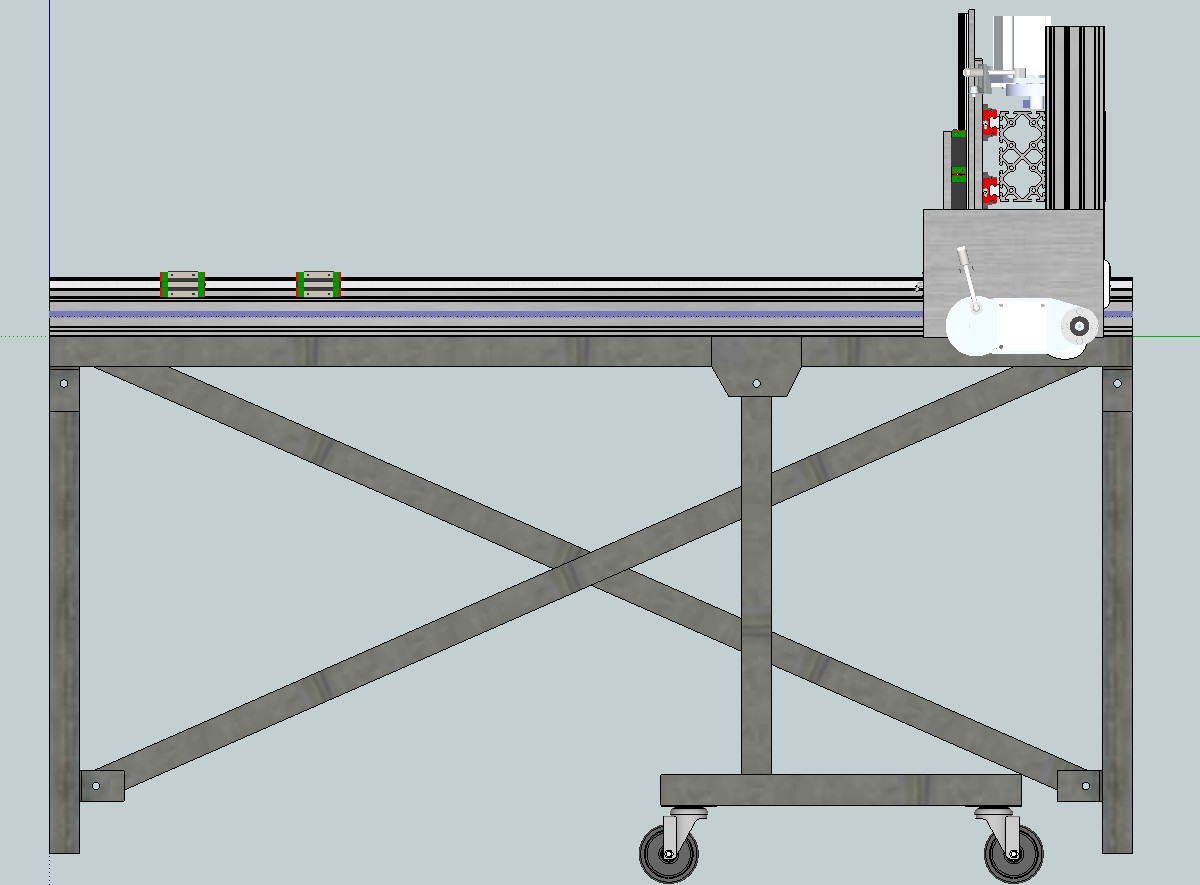
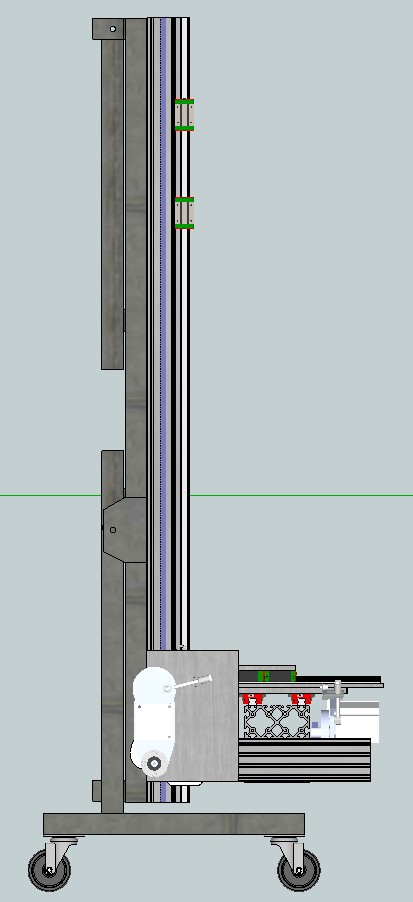
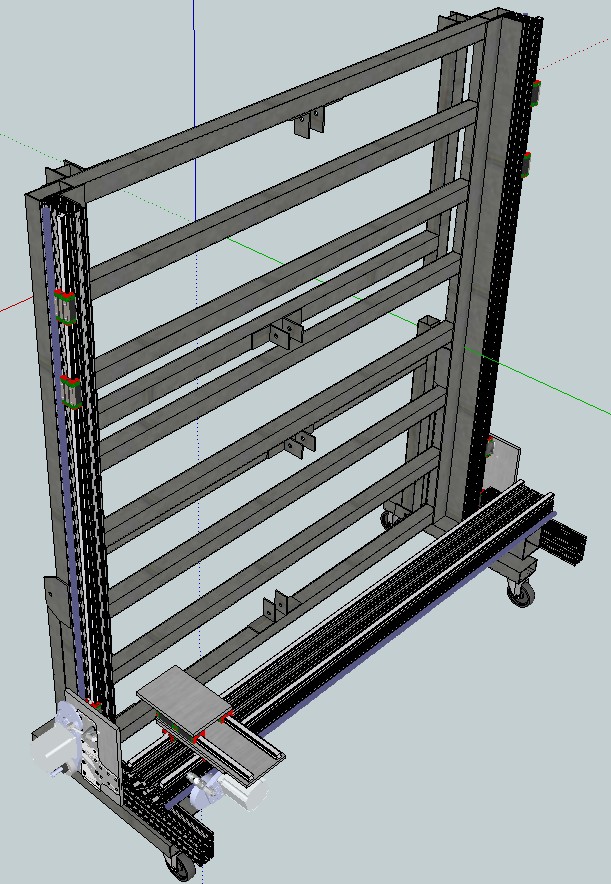
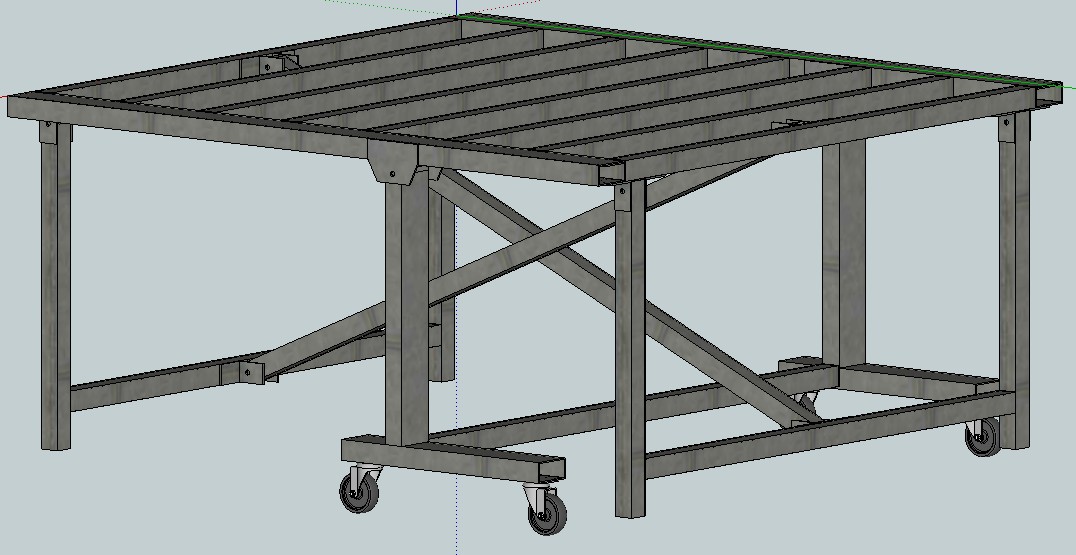
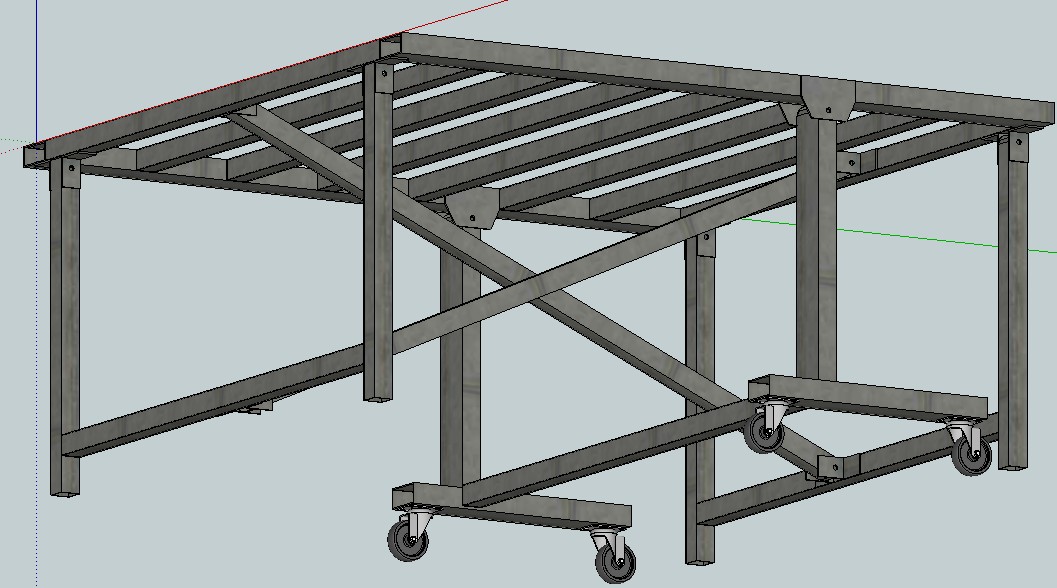
Hello, I’m Bruce and I purchased the 4x4 Altmill this month. I would like to build a table to make it movable and possibly tilting to save space. I was working on a plan for a homebuilt CNC but time keeps getting away from me. Anyway, I have a drawing for that folding table that would need to be scaled for the Altmill and am wondering what you think of it? I was thinking I could mount this to the frame members of the Altmill maybe?
Hi Bruce! I think your design is interesting but I don’t have an AltMill nor am I an engineer.
I do have a LongMill Mk1 and I know it puts a bunch of force into the table with direction and speed changes. The AltMill has more mass in motion at higher speeds so I would expect even more force trying to shake the table. I can’t put a number on any of these forces but expect quite a lot if your not already.
Are you planning on welding this or is it all bolted?
Does your table have just one set of cross braces in the center? Is that what the ‘tabs’ are for in the 3rd pic? I also can’t tell if the two sides with the casters are connected by anything other than the table. I don’t know how much the AltMill weighs but I’d want them connected at the bottom. But then again maybe it’s not needed depending on how tight things fit and what material and thickness your going to use.
I’m also not sure where you plan on mounting the electronics. The assembly instructions show them on a leg but that might not work for you with folding legs. Nothing you can’t overcome, I’m sure, but something to keep in mind.
Maybe some of my questions will help someone with more experience evaluate your design.
@bthabel You need the ability to fold the rear legs before you can tilt the table. So you’ll have to work out the clearances and turning radius. And obviously you’ll need a way to transfer the load from the cradle to the legs. Adjustable feet is probably what I would use.
You’ll want to adjust the geometry so that the centre of gravity is as close to the pivot as possible. That would require determining how far back to move the x-axis when tilting the table.
Thank you both for your replies. @_Michael thank you for your questions as they are helping me go back over this. I am planning to weld the table together. The two sides are connected at the bottom with a runner between them. There is one cross brace for each of the legs. As far as the electronics, I am planning on placing a plate on the side of the table that I will be able to drill and then bolt them to.
@Chucky_ott, thank you for your thoughts on this. My current thought is to use adjustable feet on the legs as my garage floor is unlevel due to the floor drain. I want them adjustable from the top or side rather than having to get down on the floor to level things up. Something along the lines of threaded rod with a nut welded on the top and a foot at the bottom, going through a threaded rod coupler, or two, that is/are welded to the leg. This would allow me to use a socket, extension and rachet to adjust the feet from a standing position. I hope that makes sense.
Thanks for the 3/4 views. They give a better look at how it all fits together. I originally thought the same as @Chucky_ott, ‘How are the back legs going to fold up?’. I eventually figured out from the 3rd pic in your OP that the legs fit between the casters.
I like your threaded rod idea! Anything we can do to save our backs, knees and hips is a good idea in my book. I wasn’t so clever so it’s look at the level then get on the floor to make an adjustment, repeat as necessary.
I’m also glad you know how to weld. That’s something I’ve never learned. Should be stronger that way as well as easier to add more cross bracing if you find out it’s needed. My table is 2x4 construction so it’s not a direct comparison but I had to add more bracing after I got my mill set up. My original plan was to screw it to the wall but that made the whole house hum!
I also think it will be important to minimize the play in your pivot joints. Any slop could add up and let it rattle and shake.
Thank you for your input. It is much appreciated. I know how to weld but it’s been a long time since I’ve done it on a regular basis! I am planning to make the joints fairly tight to begin with but they will be bolted together so they can be tightened as needed. Thanks again! And a Happy New Year to you!