Hello, I have the Altmill 4x4 with an AutoZero touch plate. I have a question on a tapered ballnose bit. I have an Amana 46473. Which is 6.2 degrees and a 0.25 radius tip. I am hesitant to use the AutoZero for XYZ. Can it damage the tip? I have already had to replace this bit once because a dropped it. I am not trying to spend another $85.00 if I mess it up.
@tresguey I’ve asked myself that question a few times. But the AZTP is aluminum, so much softer than a carbide mill. Would love to know if someone looked at a bit with an electron microscope after zeroing.
That said, I don’t think I’d XY zero a TBN with the AZTP. I don’t know if the taper on the bit is factored in when zeroing. I’d only do Z zero. I would put in a straight bit to XY zero and then use that for the TBN.
2 Likes
Agree with @Chucky_ott - Use a different bit for the XY if needed and use the TBN to set the Z only.
Thanks for the replies, I was thinking the coating was hard. I do a bunch of vcarve inlay cutting boards and have always zeroed with a paper. figured the AZTP would be more accurate.
If using the AZTP in auto mode. I don’t this the taper maters for XY since it is finding 4 sides. Unless I am mistaken.
As I understand it, the AutoZero Touch Plate, if you have not told it the diameter, will touch all four sides, some distance up from the tip and average the center for the XY location after first touching the tip to the bottom of the plate surface for the Z location. I have never tried it.
Yes, you’re probably right. Any error due to the bit geometry - especially on a small mill - is probably negligeable. But it is a tapered spiral with a cutting edge and a throat. So depending on which part of the bit hits the AZTP, it may not be perfectly centered.
I would be very surprised if the AZTP is aluminum. It has substantial mass … more than I would expect with Aluminum.
Having said that, I do not believe that under ‘normal’ circumstances the bit would be damaged when probing Z. The reason I say ‘normal’ circumstances is because of the occasional uncontrolled motion of the Z axis which will definitely damage an endmill. This doesn’t happen when the system is probing but it can most certainly happen when you are manually bringing the endmill close to the AZTP in preparation for a probe cycle.
@Jens The docs say 6061 Aluminium
I sit corrected ! spare characters to make the system happy
I have the auto zero touch plate and wow the bit barely even touches it as it’s an electrical probe. As soon as the electricity flows it’s done.
But for sharp pointed bits, use the “tip” setting.
I can’t imagine it damaging a bit. I’ve got bits as small as 0.4mm, very delicate. And I’ve broken a few of the very small bits, but never even scratched one with the auto zero plate. It would be a much bigger risk trying to zero the Z by hitting the button in the “precise” mode in gsender.
That thing goes down very slow and as soon as it gets just close to the bottom, retracts immediately. I wouldn’t hesitate to use the auto zero plate with any bit.
2 Likes
Have not but could if needed. This is my microscope zoomed all the way out. Send me new tapered ball noses and I will do experiment for free, zooming all the way in on tip.
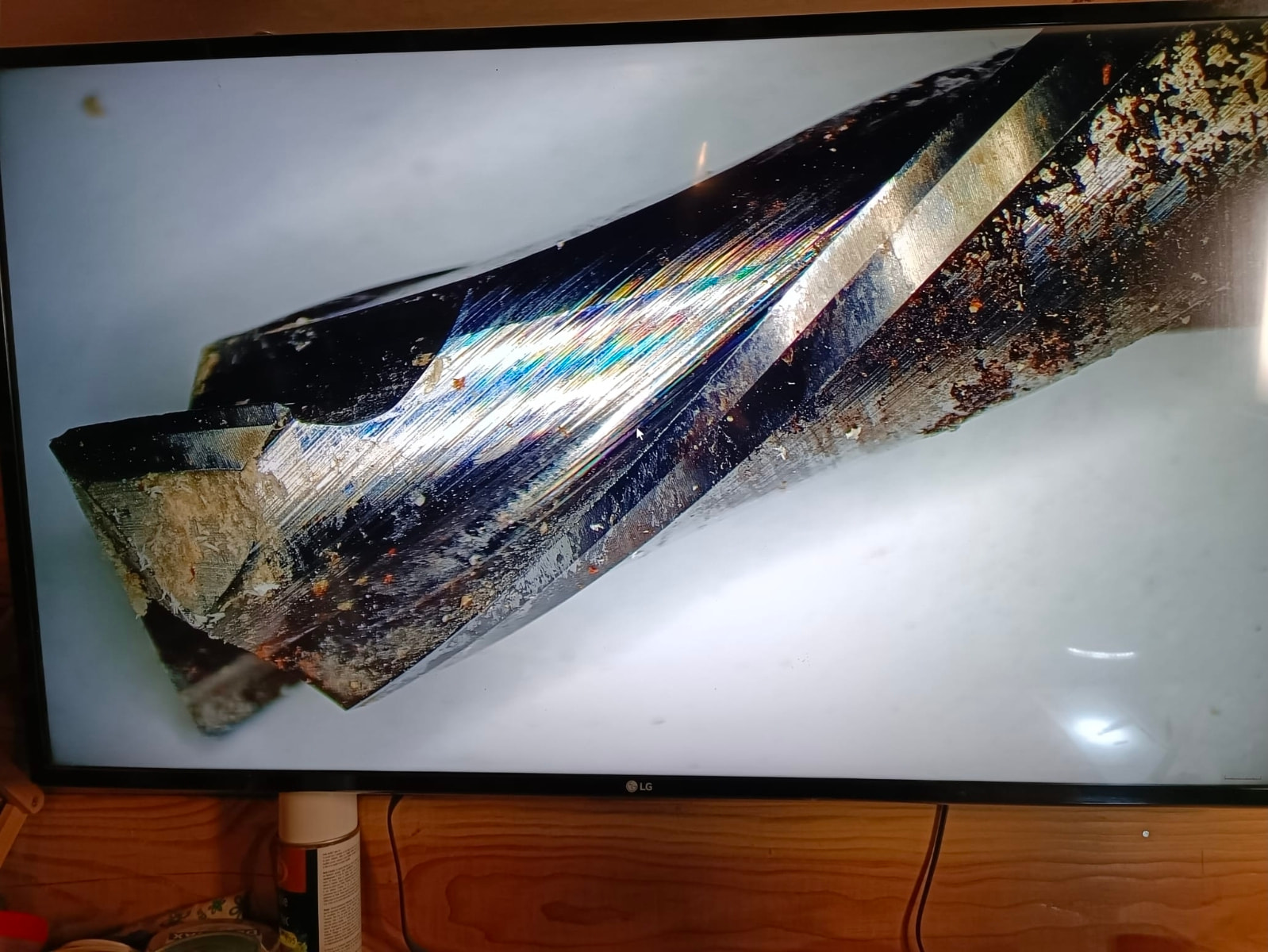
For free!
1 Like
Hello all,
I have been taking the course put on by Nik Broinwood (New Inlay Toolpath V12) to help me dial in my parameters to void gaps. He seems to use the center of the board to zero the bit, but I like using the Auto Touch Plate on the lower left corner. But is the Auto Touch Plate an issue? I zero the end mill usually a 3/16 clearing bit with the AZTP using the “Auto” setting. But when I switch over to the TBN can you just zero Z? With a bit using a Tip you need to zero the bit with the “Tip” setting. I have been re-zeroing using the AZTP each time I change the bit. That way I can set either “Auto” or “Tip” depending on the bit. Not really sure if this is necessary or not. Once I get a good result (correct numbers) I will try only zeroing the Z. I haven’t seen any issue with damaging the bit. I can’t put it under a microscope but just looked at it under a magnify glass, no issue. The AZTP moves very slowly.
tresquey, to put your mind at rest, try doing this, set up a TBN and set the AZTP to “Tip”, set up the AZTP for zeroing as you always do but don’t hold it. You will see that the machine (mine is a longmill) doesn’t move the plate (I just tried mine again to make sure before I posted this reply). So, if the machine doesn’t move the AZTP I feel that there isn’t enough pressure to damage the bit. Just my 2 cents.
1 Like
Chucky_ott or jens it seems you are from Canada, where do you buy your bits? I having trouble buying good quality bits. Thanks Pat
All my bits are courtesy of Amazon.ca. I buy a lot of SPETools bits (but only in packs of 5).
I have also bought 1/8 endmills and 1 mm drill bits - those were not TPE but Hozley for the endmills in a ten pack and Uxcell for the drill bits (in ten packs).
I try and stick to bits that Amazon stocks rather than getting those that are shipped from China.
I am sure I had others but I am not going to dig through all my past Amazon purchases.
I have not had any bits that I was not happy with!
1 Like
I don’t want to get off topic but Spetool on Amazon for me as well. And I have a bunch from Sienci (End Mills & Bits | Sienci Labs). They now have quality bits in their inventory.
I’ve looked at these suppliers too but have not ordered yet. I’ve been a client of Lee Valley and KJP for a long time but they only started carrying end mills in the last few years.
I took Nik’s course as well, This is why I am using that Amana TBN. He uses a tool setter to zero his bits on a tool change.
Thanks all for the advice. Much appreciated!
tresquey, not sure if you are in the USA or Canada but Nik no longer uses the Amana TBN bit. He is also finding it too expensive. He is now using CIC Workshop (Cutting it Close) bits. Here is the link to the bit that Nik uses. CIC doesn’t ship to my address. TBN-62124 - 0.25mm Rad. - 6.2 Deg TBN- 6mm Shank — CIC Workshop
Hey Pat, Yes Nik did let me know that he is now using the CIC bit now. I planned on checking them out when my 2 bits are end of life. Either that or the IDC 6° TBN, slightly sharper angle with his.
Hi tresguey, I just figured out the measurements for the Freud 72-300. It is a 6.2 degree (set up as a V-bit with 12.4 degree angle) with a 1/62R. I used 6mm PD, 4.5mm GG and 6mm SG. I just did the Logo for the carving club I’m in on a cutting board and it turned out great, no gaps. I ordered the CIC bit and had it sent to a friend in Connecticut and she will send it to me. I will then try it against the Freud. I don’t see how it can be any better results. When I get the cutting board finished I will post it.