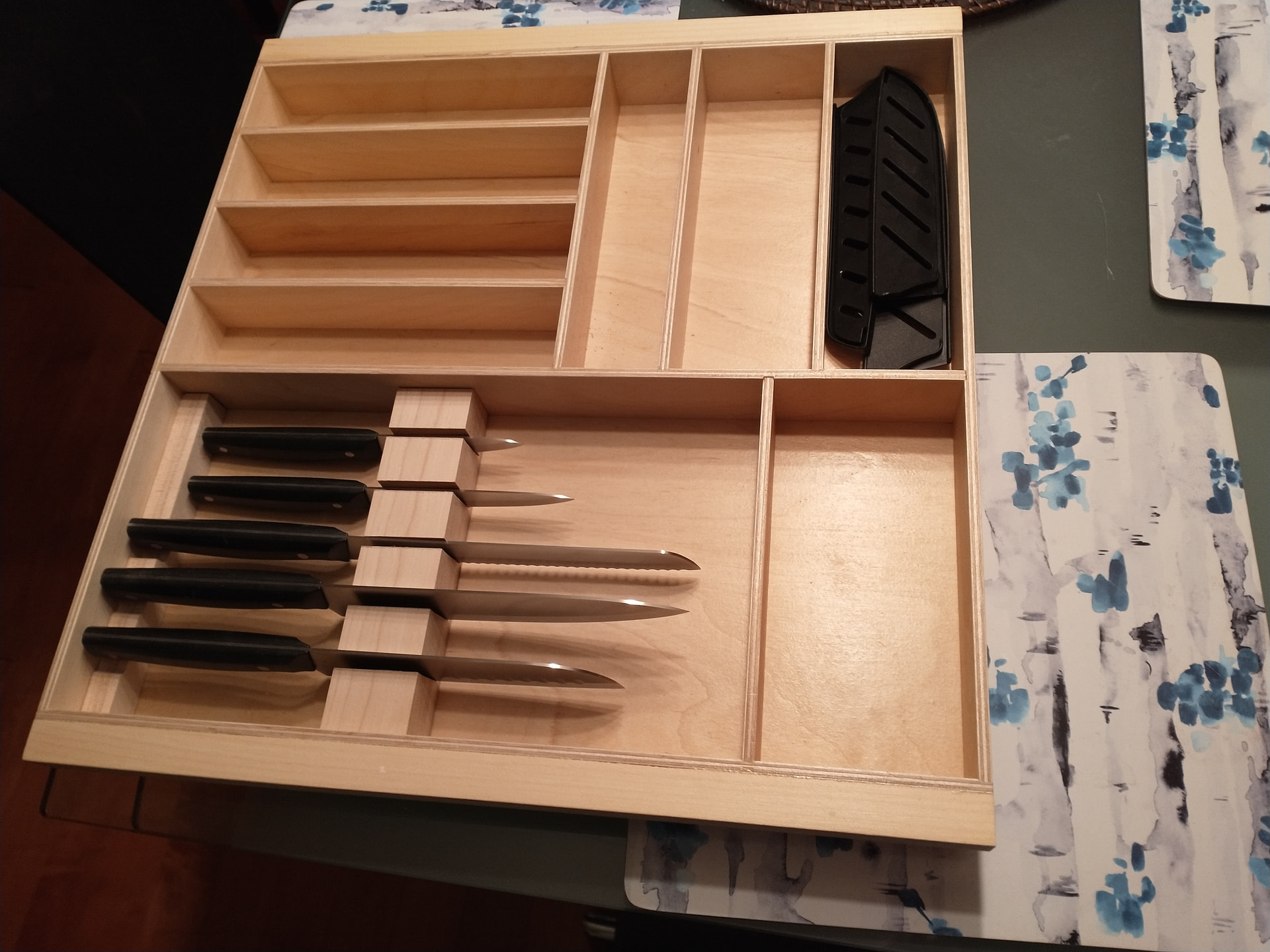
@Jens I know you have been having challenges with hold-down methods for plywood. I finally tried to mill some grooves in 6mm Baltic Birch plywood in order to do a cutlery tray for my daughter. It’s enough to make a grown man cry.
Plywood isn’t flat
Plywood isn’t even thickness
Spoilboard may not be flat (although it is still pristine since the last time I surfaced it)
Spent too much time trying to clamp it with double-sided tape, only to have it bounce back…and that’s after sealing the MDF spoilboard and plywood with WB poly.
I finally got decent results but it would have been nice to have a vacuum clamp and a surface mapping feature in gSender.
Whenever I want to see if whatever project I’m working on is kinda flat, I pull out a small piece of wood, xy center it on the piece and z-zero on the piece of wood now called “the tester“ and start moving my y and x out with a set distance while having z on zero. If I can get my tester under the mill after jogging, I’ll just wiggle up and down to have a feel of the space between the mill and the tester.
It isnt too accurate, but it’s a quick way to see if something needs a surface job or if it’s close enough. Sometimes I even determine where to set z-zero, to even out the none flatness a wee.
I use pine instead of a metal block to prevent me dulling a perfectly good bit.
Untill there’s an actual surface mapping feature, I am using this as a rough quick fix.
Let me rephrase - you can certainly resurface it but what you end up with is a piece of unusable crap.
What you could do is to put the proud area on the spoilboard and use clamps to bring the sides (that are now proud) flat to the spoilboard. I have not tried this and I don’t know what the likelyhood is that the plywood is bowed in more than one direction where this technique would likely fail. I certainly would not be surprised about a multi-warp/bow situation.
@Jens it’s exactly as you suspected. Putting it concave side up is what I wanted to do but it curves in one direction along the grain but curves in the other across the grain. So even with all four sides pressed flat against the spoil board, I still had some bounce.
I have a dial gauge indicator that I could have mounted on the spindle and move it around to see how flat my stock would be. That’s what I do for the spoil board. But as @jens says, on plywood, I wouldn’t have been able to do anything about it.
Perhaps having done it would have made me switch to something else. A better plywood or other type of flat board suitable for this project.
@Chucky_ott I can truly sympathize. We just had our kitchen redone and I bought hard maple at a good price, glued up drawer-sized blanks and did all my drawer dividers, including cutlery trays with that. Thanks to having a jointer, planer, table saw and CNC, I had no warping, bowing, cupping issues. I can’t imagine doing this in plywood. That said, I’m surprised that baltic birch ply was that bad. I’ve had quite good results from it.