@KGN Tks much, Kevin. I’ll be first in line.
1 Like
Is the main reason for wanting an ethernet connection to alleviate any connectivity issues with USB or is there any other value?
@DavidB I can only speak for myself. Early in the life of my Long Mill Mk1, I had constant disconnect issues with the concommitent ruined projects. I followed the then-current advice. I grounded everything that got in the way. I bought gold-plated USB cables, I installed filters, I slowed down the communication baud rate. I still had intermittent issues.
When the SLB came along, with its ethernet connectivity, I beta-tested it. It had all kinds of excellent improvements over the Long Board, but the ethernet was the selling point for me. I have had NO connectivity issues since going from USB to ethernet.
That’s why, speaking only for myself, the SLB-lite, in its current form, is a big step backwards. I’ll be first in line to buy the expansion board to get back to where I am now with the SLB.
1 Like
Ok so question… would a ethernet to usb c adapter allow the SLB-LITE to work until the proper expansion board comes out? 
@Derekh1979 Even if it does, I doubt you’d gain anything because you’re still using USB at the controller.
1 Like
@Derekh1979 I’m with @Chucky_ott on this. When the SLB was introduced, Sienci had only tested connectivity using a static ip address. So, if the CNC-connected PC was on a home network, there were 2 options. One was to install a second NIC into the computer. The other was to get a USB to ethernet dongle for the pc so that the connection to the SLB was ethernet. I went with the first option. It didn’t make sense to me to go with the dongle. While that option did remove the USB cable from the equation, I believed that it still had the inherent USB issues. I was lucky, I guess, in that my PC had an open slot to install a second NIC.
Now, with the SLB-lite, it would be the opposite scenario. Ethernet would run from the PC to an ethernet to USB dongle connected to the SLB-lite. I am not USB savvy enough to know if this would be better than a straight USB connection between the SLB-lite and the PC. In my ignorance, I doubt it.
1 Like
The biggest pro a eth cable has over a usb is that pretty much all eth cables have the wires in twisted paires to mitigate internal signal leakage between signal lines. Most (cheap) usb cables don’t have twisted pairs. They are available, but one needs to look at the specs for the usb cable to list it specifically. It’s nkt even a given when buying a shielded usb cable. I believe Eth cat 5 and above have standard twisted pairs and if I’m not mistaken, cat7 is shielded.
Another pro for eth lies in It’s protocol that has feedback to check dataloss. Usb has an inherent weaker protocol to catch errors.
That makes me wonder if the ethernet housings on the SLB and SLB-EXT support shielded ethernet cables? I know other higher end CNC’s recommend shielded ethernet cables to reduce interference.
@Spamming_Eddie Exactly! Just before the SLB came out, I had finally gotten some semblance of reliability with the USB connection. That came from finding a shielded twisted pair USB cable and from reducing the communication baud rate. Unfortunately, I did not come at the problem scientifically, so I can’t know which of those changes solved the problem or if it was a combination of the two. At any rate, it academic shortly after I implemented them, since I jumped on the SLB as soon as it came out.
1 Like
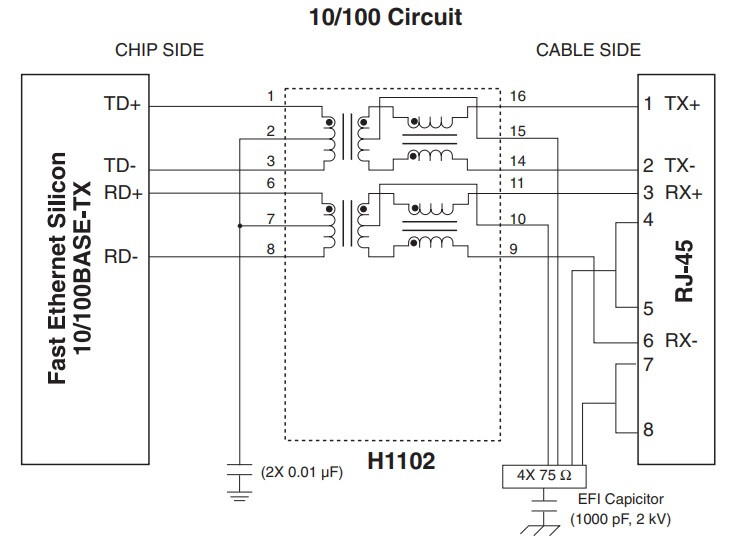
The whole idea with Ethernet is it has differential pairs which are transformer coupled at both ends of the cable.
When EMI noise hits the cable each wire of the twisted pair gets (nearly) the same noise. Since it is differential, the noise is cancelled out when it reaches the transformer.
Secondly, there is no direct (electrical) connection from cable to the Chip side. Electrical potential differences between the object (SLB in this case) and computer are isolated by the transformers at each end of the cable.
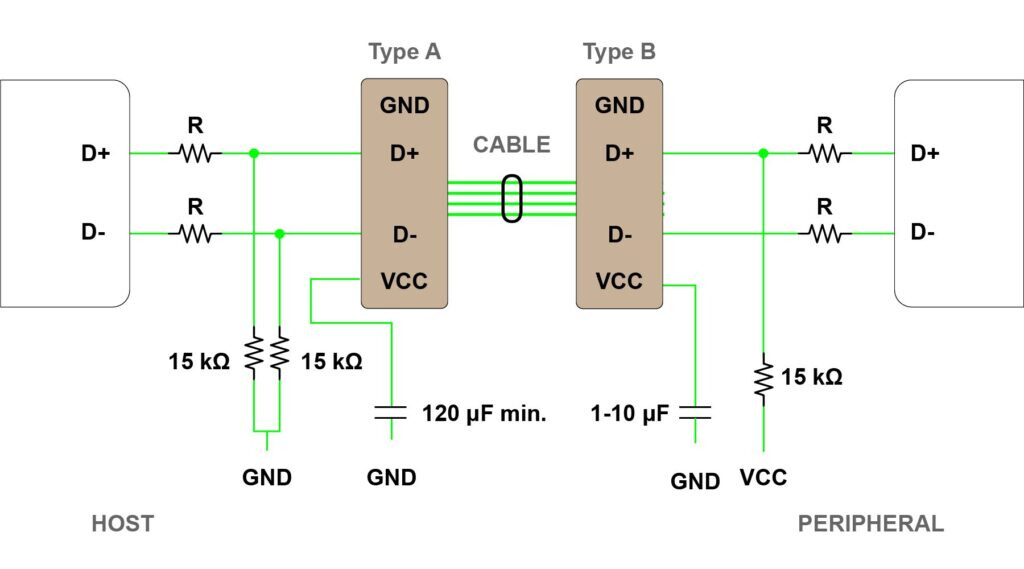
USB, on the other hand, has no isolation. The differential pair D-, D+ is directly (electrically) connected to the chips at each end and a ground wire provides the reference. EMI noise on a USB cable is coupled directly into the chips at each end. The USB data pair has some differential immunity, but still the noise on each wire of the pair is directly connected to the Chip.
Furthermore, if a potential exists between the computer and the object, you are likely to create a ground loop where current is going across the ground reference wire (data wires, VCC power too). This can lead to component damage at each end and smoke/ melting of the wire/cable. [Trust me… I have encountered this. This is the reason I don’t use USB between a computer and another device which has its own power supply.]
USB Circuit:
1 Like
So… If I want to purchase a MK3 and insist on an Ethernet connection I either have to purchase a SLB-Ext, or purchase the accessory board for the SLB -Lite … Correct?
Probably.
Prior post from @kellyz said SLB would not be compatible but it didn’t say anything about the SLB-EXT.
@R.Portman Roland: Did you ever get a reply from Sienci as to whether the Mk3 can be used with the SLB-EXT so that it can connect with ethernet? I have not.
I can’t say this officially but I have investigated and it’s not compatible with the MK3 apparently. Don’t quote me because this is just what I am reading and hearing.
@Derekh1979 Thanks, Derek. I knew that the SLB wouldn’t work, but I was hoping that the SLB-ext would. Too bad.
1 Like
Yeah unfortunately like I said this is just what I have been informed.
1 Like
@Derekh1979 I’ve asked again, Derek. When I get a reply, I’ll post it here.
I just learned that the new and improved SLB-lite does not support the Sienci Vortex either. It seems that will be another add-on; availability date to be determined. So, it’s even more important to learn if the SLB-EXT can be used with the LM Mk3. That would address all these failings of the SLB-lite.
Edit. I see that the new track is now available in the store. However, the necessary power adapter does not seem to be available, so there is really no point in getting the track just yet.
1 Like
I begin to wonder in the logic in making this lite board to begin with. Would have been much simpler logistically and for people to understand if it was designed to use the SLB-EXT to begin with.
1 Like
If Sienci says the SLB-EXT isn’t compatible it would be nice to know why it isn’t. Is the reason something superficial like, ‘We used different wiring connectors to save space.’? Or is the problem something fundamental like, ‘The voltages are wrong.’ or ‘The stepper drivers built into the board are incompatible with the motors.’?
Bear in mind electronics aren’t my specialty but it at least seems possible to me that ‘Not compatible’ could mean ‘It doesn’t work out of the box’. I realize we don’t even have the ‘not compatible’ answer yet but I thought I’d post this in case one of you has the opportunity to ask a follow up question.
EDIT: It just occurred to me that some of you already have the LITE board so wrong connectors was probably a bad example as you’d already know that but in my ignorance of electronics it was the only superficial problem I could think of.
I have my fingers crossed for you. I hate to think an upgrade in your mill could be a downgrade for your accessories.
@_Michael You raise a good point, Michael. I am leaning to the issue of cables, too. I’m sure that the motor ends are the same, but I’m willing to bet that the board ends are not. Andy made a point of talking about the more streamlined cabling that they developped for the Mk3. So, all else being equal, not only would I need to buy an SLB-EXT, but I would need to buy compatible cables, as well. I’m reasonably confident that the cost of the Mk3 expansion board and the new Vortex parts would be less than that. Time will tell, though.