I’ve been looking at gSender, and like what I see. It seems to handle almost all of what I normally need, and looks like it does it better than my existing machine control program.
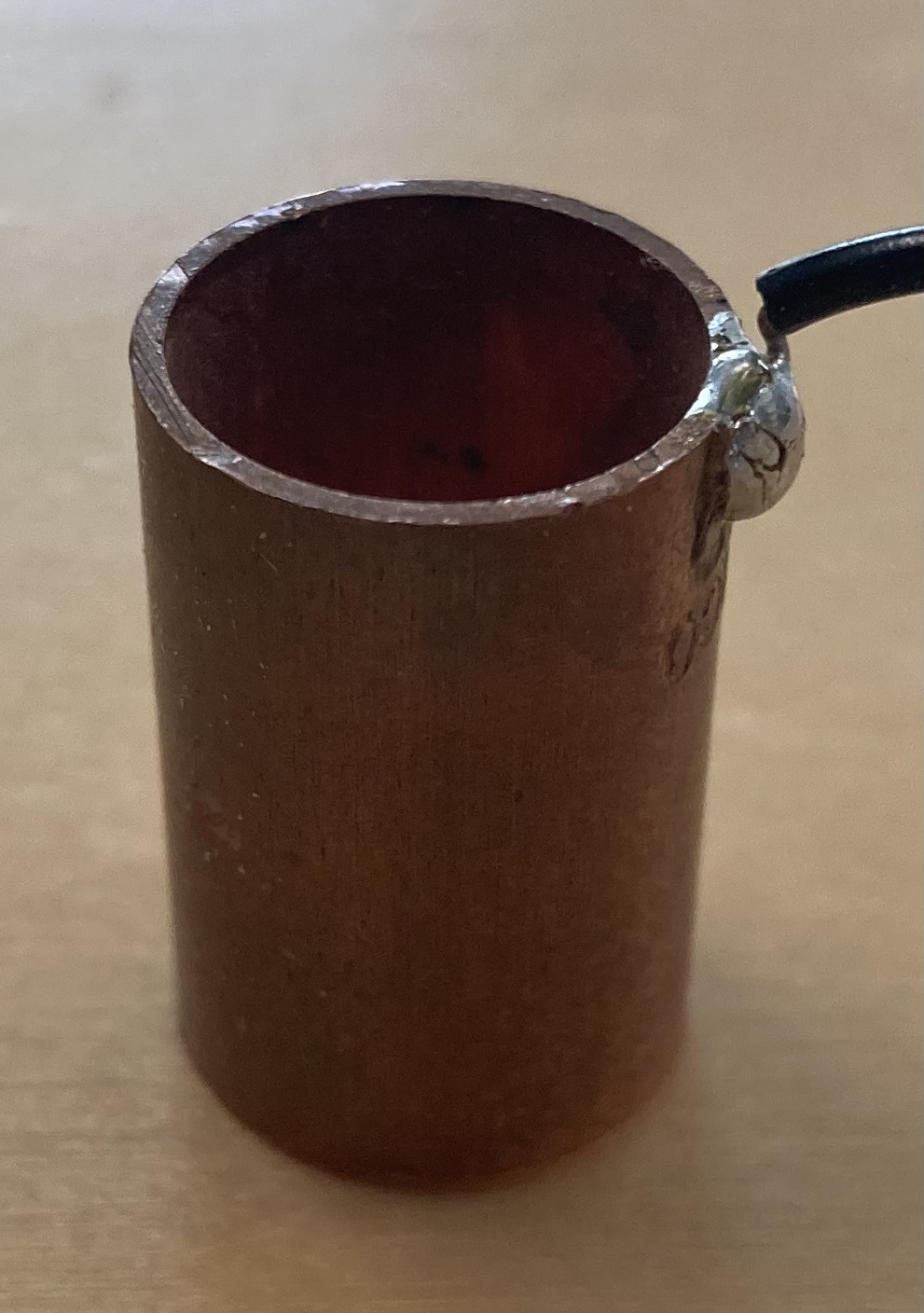
One possible exception is a probe routine to find the center of a hole. I have a technique where I use a simple copper plumbing fitting as a dowel. I can solder a wire to the dowel, then use it to register the machine to the hole center, since the plumbing fitting is just a thin wall cylinder. This is all done with simple electric conduction, though I’m thinking of buying a 3d touch probe for $100 to simplify and generalize the process.
Anyway, I didn’t see a probe routine to find the center of a hole in gSender, after watching an in depth video. Is there such a routine, or could it be easily added. I use this technique quite a bit.
@NeilFerreri As usual, Neil, your stuff boggles me. One question, though. The code assumes that the hole itself is bored in a material that is a conductor, yes? In other words, this cannot work to find the centre of a hole bored in wood??
I would assume that as well. That’s why I use a copper plumbing fitting as a hollow “dowel”. I can insert it into a previously cut dowel hole and I’ve got my conductor. However, 3D touch probes are now affordable, so I could skip that step and use any hole!
@jandyman Understood, tks. I guess to be accurate, the hole and the OD of the pipe must be pretty much exactly the same. Do you mind explaining when and why you use this? Tks.
Yes, I cut the hole to be exactly the diameter of the fitting (.565") . I’ve used this system because I need to flip over parts like bass bodies and necks, and location is critical when doing that. Whatever system I use to secure the stock for the first side cut, I create two dowel holes in the top of the stock and the spoil board at each end of the work. It might be days later when I finish the top cuts or get around to flipping the piece over, and I don’t trust the homing switches to find X and Y accurately, so I just the probing routine and the plumbing fitting to locate X and Y zero, whether it be using the spoil board holes or the holes in the piece, depending on whether I’ve flipped it or not. Hope this make sense. I am thinking about other ways of doing this, but it has worked well so far.
@NeilFerreri Reading your reply made me realize just how much is possible with G code itself, and gave me an idea about solving a problem I’ve been thinking about for a long time - how to create a precise relief curve for an electric guitar or bass, even with the strings on. Let’s imagine we are talking about a 48x30 MK2 mill, and we are assuming that the gantry is perfectly straight. If we could use a 3d touch probe and probe the top of the neck at a few different points along the neck (between the strings and avoiding the frets), and gather that data, it would be easy to figure out the exact relief profile. This is sort of a holy grail, as measuring with a straightedge and feeler gauge is really error prone. The numbers we are talking about are small - the maximum deviation from straight (the “relief”) on a properly set up bass guitar neck is between .015" and .025". But as long as the 3D touch probe is sensitive enough and the gantry is completely straight, this could really work. The trick is being able to save out the measured points somehow. How would one do this, and does this sound crazy?
@jandyman Thanks for the explanation. I do a lot of two sided machining. I use 1/4" aluminum “dowels” in 1/4" holes to ensure that the top and bottom are precisely aligned. The technique is well described in both the Vectric videos and those of Mark Lindsay. I’m sure that you’ve seen that technique and found yours to be better, though.
As to 3D probing, there are commercial probes available, like this one for example
Hello all, after using a few different G code senders I’ve found that i like Gsender most. One thing that it lacks though that many others offer is the ability to perform extra probing routines ie: inside of a hole or outside of a cylinder to find center, center of two points in X or Y, workpiece alignment. Integration of these features would make G sender “muah chefs kiss”
Not sure if it was already asked. But if you could just add one additional macro to probing with the 3D Probe it would be awesome. Center Hole probing. Thank you very much guys
Maybe this macro would work for you. It’s for CNCjs but gSender is based on CNCjs so it should work. I know Neil’s macros were used for various things before gSender supported them. His bitsetter macros come to mind.
You should read the macro and set the ‘user defined variables’ to make sure it’s setup correctly for the size of the hole you want to probe.
Hello Michael. Its a very simple macro, so writing it is no problem. But i asked about having it on the probing tab of gSender because they recently added support for 3d probe, but not hole center probing which is kind of the most important one with a 3d probe.