I’m in the process of tramming my new Altmill-
Tilt issue I’m looking for guidance with-
With the tilt tramming, I can only get the eccentric to adjust with about 0.006" over a 4.5 inch distance which is pretty bad, there’s no more available rotation on the eccentric. The closest to perpendicular is with zero camming action.
Solutions for this?
@GreenMachine Is your Altmill so out of alignment that you need more than that?
Did you surface your spoilboard before tramming? You need a flat surface to tram and your spoilboard will not be flat until surfaced.
I’m using a granite surface plate and a dual indicator. I think I have it in a good spot now…about 0.0015 over 4", but that was achieved by basically loosening the bolts and pushing it with my hand into position, tightening bolts, re-adjusting, untightening, readjusting etc. The eccentric would only tilt the head in the wrong direction when it was camming…kind of strange. I’m wondering if the orientation of the lobe engagement is side to side instead of up and down?
I think you are supposed to tram the head before surfacing.
If your reference point for tramming is the spoilboard, wouldn’t you want it to be flat beforehand? Sure, you might have ridges, but at least it will be flat.
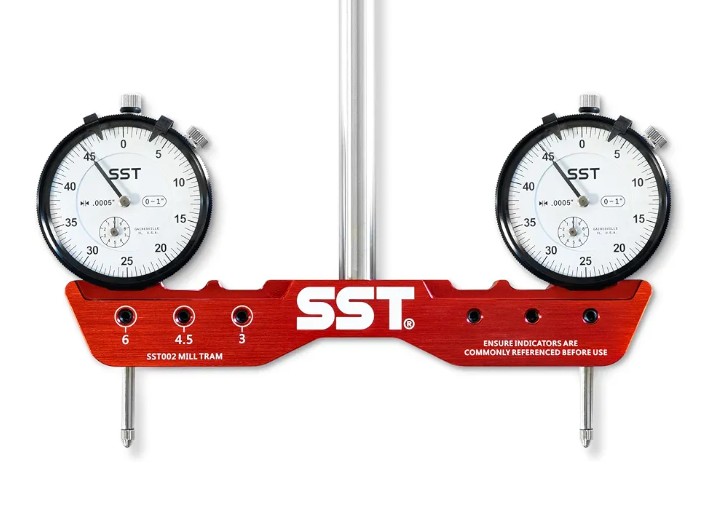
I’m assuming you’re using one of these?
That’s what I did with my tramming as well. Light taps of Dead blow hammered it close enough then used eccentric nut to finish up. My granite plate didn’t have enough clearance on my altmill I used float glass that I leveled first to the spindle then trammed it
Yes, that is pretty much the same tool I’m using. I think if the head is tilted you could wind up with some discrepancy in the surface affecting reading of the indicators, potentially more so than the surface of MDF prior to surfacing with a tilted spindle head- ridges would mean the surface under the bit is sloped, less of an issue with a smaller dia bit like a .250", but more so on a typical surfacing bit like a 2" which is what I’m using…if it’s out by 0.006" out over about 4 inches (provided I took that reading correct) and then I milled the surface with a 2" bit, I’d only be able to get the indicators read tolerance to 0.003 (since that’d be half of the 0.006 with 2" bit divided by the 4" distance between indicator anvils…i think .
@GreenMachine If the head is tilted and you surface along the x-axis, you’ll get what looks like a washboard. Essentially a bunch of parallel grooves with a concave shape (resulting from the circular bit moving along with a slight tilt). But it will be flat along the x-axis. And then you can tram for tilt.
For nod, I’d probably surface along Y and then tram.