Thank you!
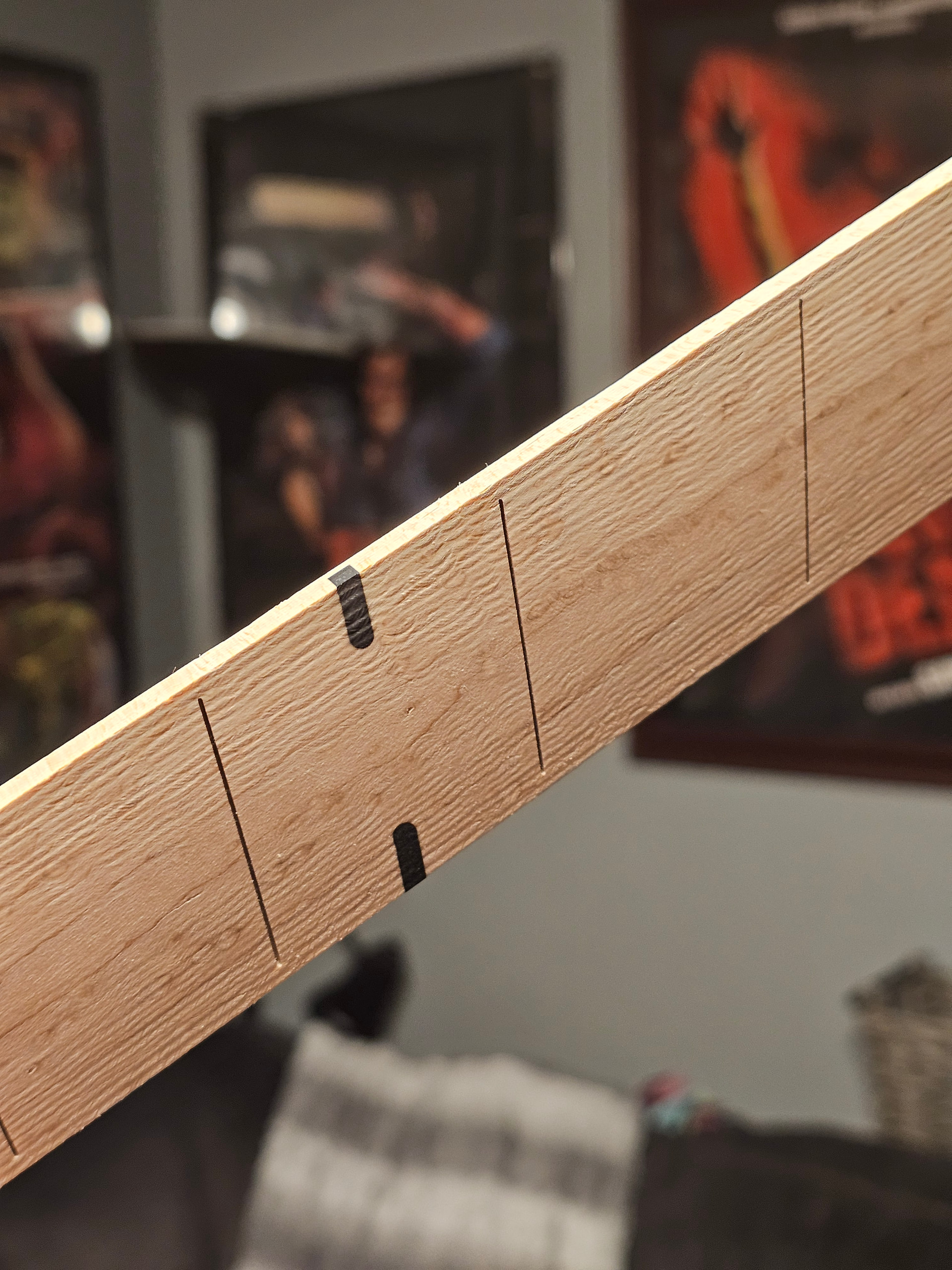
ive cut a few of these that came out perfectly smooth. Using the same exact code. Tool path is a paralell in the direction of the slots cutting the radius with a 1/4 flat. Im thinking its in the Z, but everything is tight. Whatever it is, its pretty uniform which is making it look like it ran the parallel lengthwise. If its not in code, what should I look for?
Is it the same along the entire length of the neck? That looks like it’s caused by chatter of the neck flexing under the cutting forces.
When cutting my fretboard radii I tend to use a ball nose and take a very small amount of material running parallel to the fret slots after having done a roughing pass with a flat end mill running along the length of the neck.
Also, please post pictures of that full project. I recently did a build with inlays very similar to that.
1 Like
I was pulling of 0.005” with two strips if two sided tape the lenth of the FB. It was so secure, its almost impossible to remove (using super glue and masking tape moving forward) Roughing was actually smoother. It does look like chatter, but the operation was smooth as butter. Im always taking very conservative cuts.
Is it possible for code to become corrupt between the pc and SLB? Double checked in fusion and all looks perfect as before.
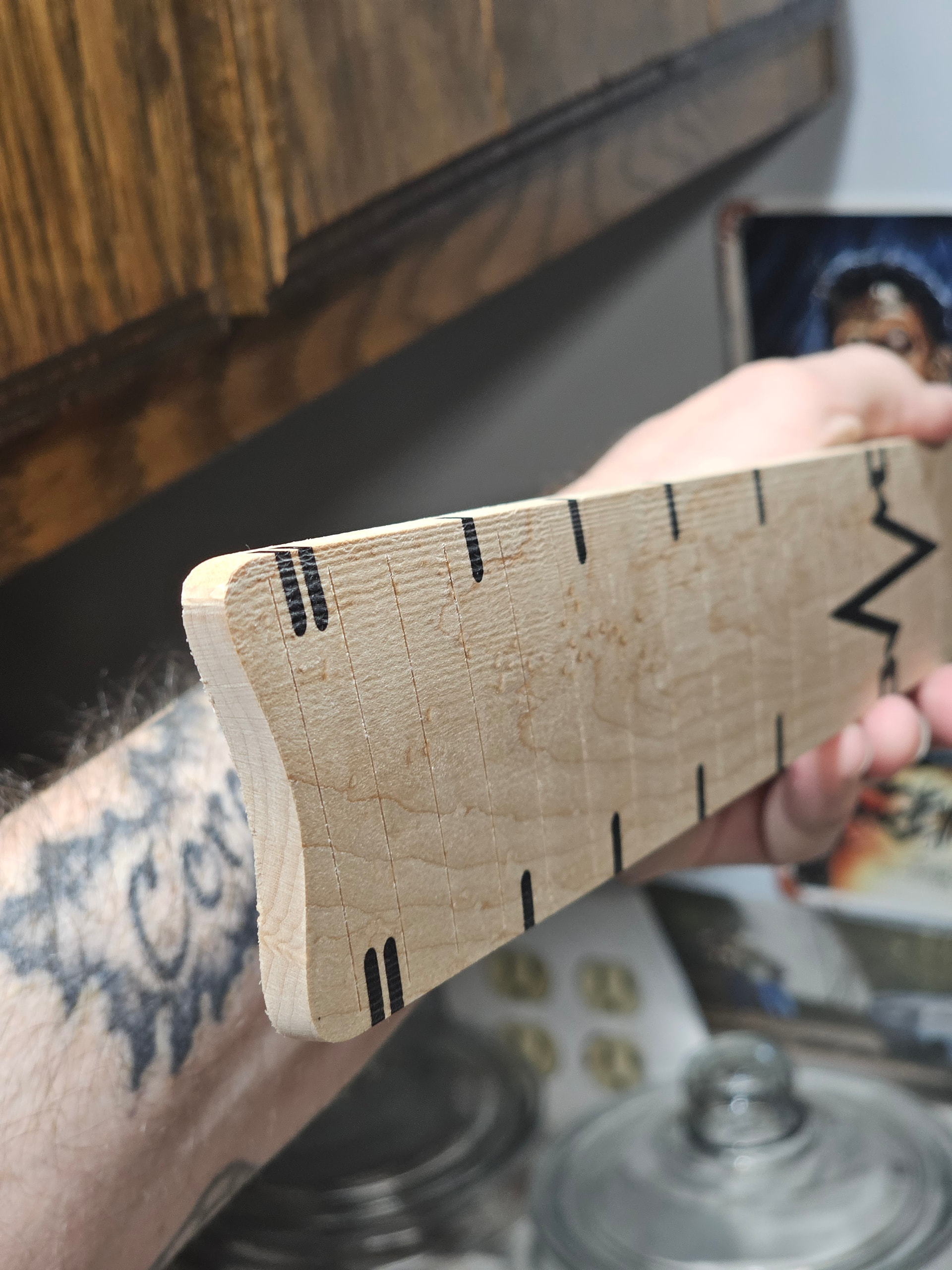
@Afterlife Damaged or dull ball end mill?
@Afterlife What is the stepover on your end mill/toolpath?
1 Like
@Afterlife I also was going to ask about the stepover but since you used the same g-code as before, I figured that it was properly set. But now that @gwilki asked, it dawned on me to ask if you’re using the same end-mill for that g-code?
Yes, same endmill. Brand new 1/4 flat downcut. Well brand new 3 fingerboards ago. Finishing step over is 0.005 removing 0.005 stock at a super conservative 50ipm @ 18000rpm. Cant visually see ‘unsmooth’ operation from the Z coupling, though its so minor the human eye probably couldnt detect it anyway. After the beautiful success of the first couple using the flat endmill (less tool changes <3) I was very caught by surprise. I really wonder if the gcode loaded weird or sent weird. I will probably try another one on a fresh load just to test that idea 
Also, to be fully clear, the lines go lengthwise but the tool paths is perpendicular at a 14” radius parallel operation
@Afterlife I’m by no means an expert, quite the opposite actually, but I think I would have used a ball end mill for the finish pass on a curved surface.
Using a flat end mill, you’re cutting with the edge of the mill. Not sure if that has an impact or not.
The pattern you’re getting is definitely interesting considering your cut direction.
Most certainly is! Turns out, a flat works great on curved surfaces as long as it goes with the curve and not along it. Doesnt work on all applications. I cut myself a radius sanding block after this board with the same bit for cleaning up the ridges I got here. Flawless finish. Ill have to grab a picture.
Come to think of it, since the block came out perfect, it must be in code. Ill test the exact code again for the fret board using the same work holding. I have a feeling the code sent weird. Just not sure if that is actually a thing that happens. Just strange because the same code worked great before. Same file. Ive been in the CAD/CAM and cnc world since December. Green as hell. Had some mishaps but no broken bits yet 

Hey Scot,
I had to wait before this thread gained more post before I even knew what I needed to look for that was out of wack. The lines looked like rough, untreated wood to me so i was looking at the lines and cutout to see what the problem was… not knowing fret boards up close, what I was looking at simply didn’t register.
I have used flat mills in 3d toolpaths milling bowls but the ridges were a feature to me and to be expeced when milling a centre outwards toolpath. This is not the same, and i have looked long and hard and tried to come up with what needs to be flexing in what direction to get this pattern.
I can only think of one thing.. the stock is able to move ah weewee tiny wee into the direction of the toolpath. It’s the only way I can see the pattern emerge when pushing a mill over and back. The tape can have a perfect hold down but if pushed enough it can, no will give way just that wee amount.
If you are going to test again, maybe use stopper blocks on the sides of the stock, to prevent this alleged movement from happening?
I made a basic fixture out of MDF which has stoppers and four hold down clamps. Then laid the stock in position using the woodworking tape and hot glued the border. That double sided tape does wiggle a bit unless you stick multiple small pieces in different directions and set it using my body weight. Ive learned this the hard way from the routing templates i made in the past  . These fingerboards ive been only doing two long strips to hopefully have a more consistent flattness across the length, the tape, mostly was just so it would survive the final contour to remove the tabs and bring to final dimension in this situation (post parallel operation). Maybe hot glue isnt hard enough and I got lucky with the other boards . I didnt add the hot glue detail for some reason
  , didnt think it could be relevant at the time. I guess I was so set on that something might have come loose on the machine side. Ill do a run on some scrap with better hold down and report back. Thank you
1 Like
What hold down method do you use when running fingerboards, may I ask? I think my current method is a little silly
My machining method for guitars is very involved and over complicated, so my method likely wouldn’t be applicable to you, but if I was to do it, is do blue tape and super glue along the length.
Now im even more interested.
1 Like
–peaks around the door–
Has he spilled the beans yet?
1 Like
Im at the edge of my seat!
Sorry lads, nothing interesting to be revealed unfortunately. I just machine my fretboards when they’re on the neck stock. Just means the work holding is inherently different.
1 Like
I had a feeling it was that. Quite involved indeed. Though im still interested in seeing the fixture setup, but understand if its a matter of national security.
1 Like
Seems like almost everything is a matter of national security in the US.
2 Likes